

You know how it goes. A couple hundred pins saved, screenshots clogging your camera roll, a TikTok folder you’re never actually going back into, and you still can’t put into a single sentence what your wedding is meant to look like. A mood board is what closes that gap.
All that scattered inspiration, gathered up and turned into one clear direction you can plan against. What follows is a simple guide to settling on a style, getting your ideas in order, and putting together a board that actually helps once a vendor’s sitting in front of you.
What is a wedding mood board?
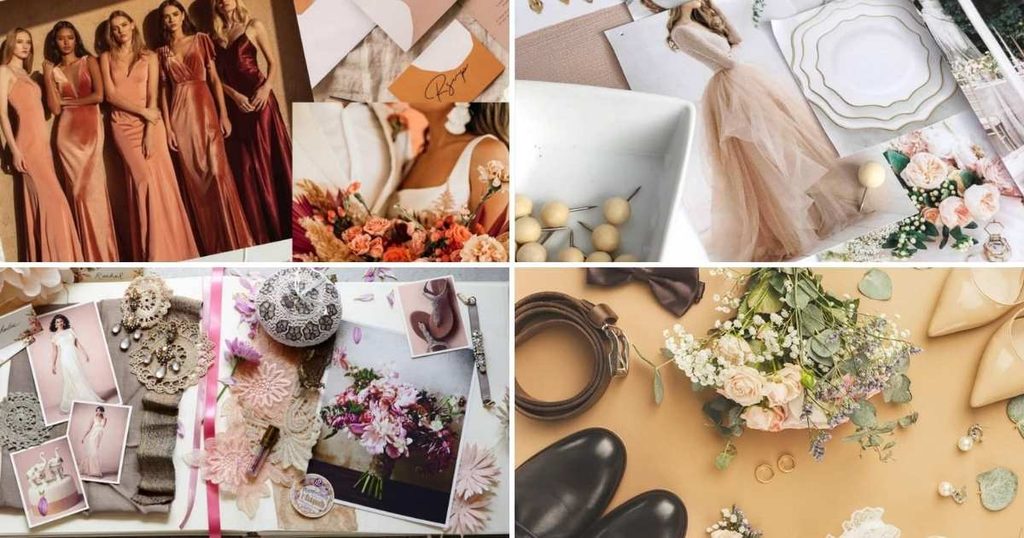
A wedding mood board is a visual collection of the colours, textures, florals, fashion, décor, and stationery that add up to the overall look and feel you’re after. All the pieces, in one place, telling one story.
And here’s what it isn’t. A blueprint for copying some wedding you found online down to the last detail. Its job is to get across the atmosphere you’re chasing, so one look tells the whole story.
Start with the feeling you want your wedding to have
Before a single colour or centrepiece enters the picture, sort out how you want the day to feel. That’s the starting point, genuinely, and the rest leans on it.
Do you want it romantic? Modern? Relaxed, elegant, playful, intimate? Maybe garden-inspired or coastal, or something that’s entirely your own thing. Pin down a few clear words that describe it, and suddenly the choosing gets easier. Every image you come across, you can hold up against those words and ask, does this belong here or not?
Gather wedding inspiration without overloading the board
Once you start hunting, inspiration turns up everywhere. Pinterest and TikTok are the obvious ones. But there’s also Instagram, wedding blogs, weddings you’ve actually attended, a venue’s own gallery, fashion, travel, interiors, even a wander outdoors.
The trap is saving everything you half-like. Don’t. The point isn’t a giant hoard of pretty pictures. It’s noticing what you keep drifting back to, because that’s the real signal.
Look for repeating details
Scroll back through what you’ve saved and hunt for the repeats. The colours that keep showing up. A certain floral style. Table settings, dress silhouettes, a type of lighting, particular materials, a kind of venue.
Those recurring bits tell you far more about your true wedding style than whatever trend is having a moment. Your instincts are already voting. All you’re doing is counting the votes.
Choose a wedding color palette
Colour is the glue. Get the palette right and the whole board suddenly feels like it belongs together.
Keep a small handful of main colours with a supporting shade or two, and skip the ten-colour rainbow where everything’s at war. Don’t pick your colours in isolation either. Your setting has a huge say in what works, so look at your wedding venue, the season, and the surroundings before locking the palette in. Colours that sing in a summer garden can feel completely different in a winter ballroom, so let the space guide you.
Add the details that shape the overall look
Flowers and centrepieces are the obvious stuff, but a wedding is built from a lot more than that. Try to gather a reference or two for each of these:
- Venue and ceremony setting
- Flowers and greenery
- Table styling
- Wedding attire
- Invitations and stationery
- Lighting and candles
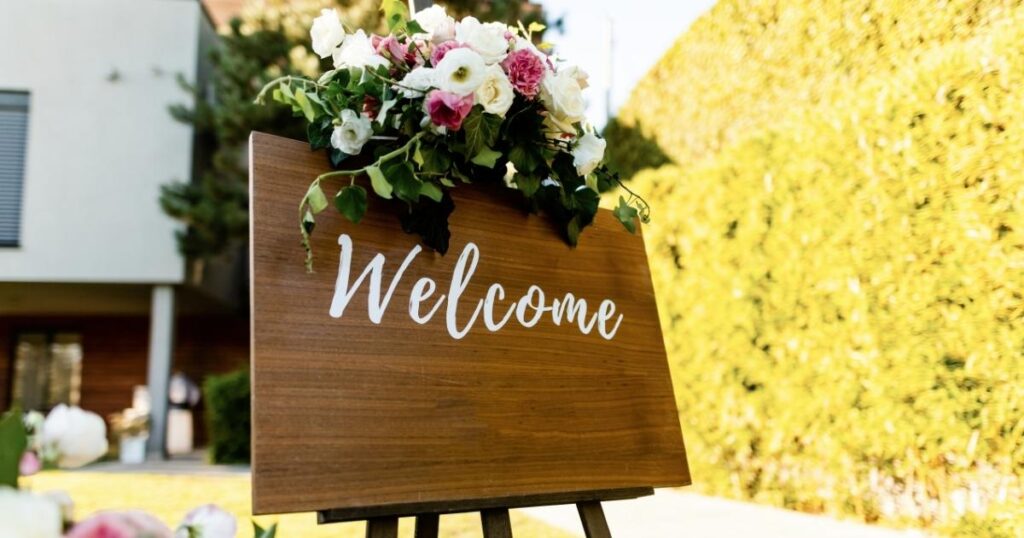
- Signage
- Cakes and desserts
- Textures and materials
You don’t need a dozen images per category, though. A handful of strong references pull far more weight than a packed wedding mood board where nothing gets a chance to stand out. Quality beats quantity here, always. Flowers are one of the quickest ways to bring a mood board to life, from the bouquet and ceremony arrangements to the centrepieces and greenery. Sharing your board with wedding florists gives them a much clearer sense of the colours, textures, and overall floral style you’re drawn to.
Keep the mood board cohesive
When it’s done, the board should read like one wedding, not five different themes elbowing each other for attention. That’s the whole test of it, really.
As a clearer direction starts to emerge, be willing to cut. The image you loved in week one might not fit the story anymore, and that’s fine, let it go. A handy gut-check for any detail is this. Would it still make sense if all the other inspiration on the board were already part of the wedding? If it clashes, out it goes.
Digital or physical: which type of mood board works best?
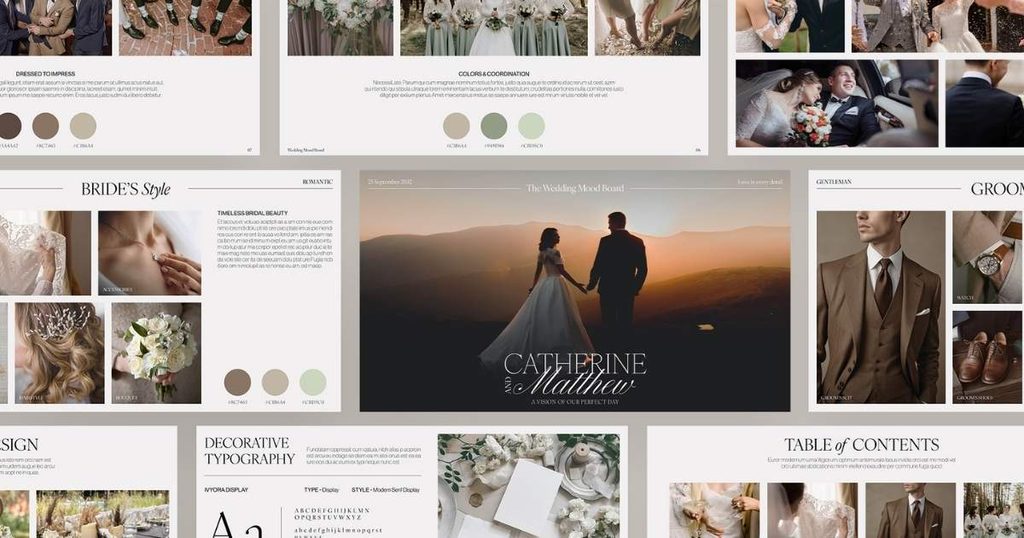
Both have their moment. A digital wedding mood board wins on convenience, quick to rearrange and quick to send a vendor. A physical one comes into its own when you want real fabric swatches, stationery, and ribbon samples laid out where you can actually touch them and compare.
Tool-wise, take your pick. A Pinterest board does the job, and so does a Canva layout, a shared folder, or a few plain slides. Nothing’s off-limits. The best format is genuinely just the one you’ll keep using instead of abandoning after a week.
How to use your wedding mood board with vendors?
This is where it earns its keep, the moment you’re across the table from a planner, a florist, a photographer, a stationer. No fumbling around for the words. You just hand them the feeling and it clicks straight away. Your wedding mood board can be useful beyond décor too. Sharing it with wedding photographers can help communicate whether you’re drawn to bright and airy images, darker editorial shots, candid storytelling, or something more classic, without trying to dictate every photo.
One bit of advice though. Share the overall direction, then give the professionals room to interpret it. A good vendor will bring ideas you’d never have thought of, and a wedding mood board that’s locked down to the last item leaves no space for that. So let it say what the wedding should feel like, not hand over a rigid shopping list to be copied exactly.
Wedding mood board ideas for different styles
The wedding mood board doesn’t have to stop at flowers and décor. Add a few beauty references too, especially if your overall style depends on a particular bridal look. Showing those ideas to wedding makeup artists can make it much easier to explain whether you’re picturing soft and natural, polished and timeless, or something more glamorous. Just a few starting points, no endless trend rundown.
Romantic garden wedding
Soft florals and greenery, candlelight, fabrics that move, pastel tones, plenty of natural texture. Gentle and a little dreamy.
Modern minimal wedding
Clean lines, a neutral palette, simple florals, contemporary type, and décor that knows when to stop. Understated on purpose.
Rustic or outdoor wedding
Warm, woody textures with flowers that suit the season, natural fabrics, and an easy, unfussy mood carried right through.
Elegant evening wedding
Deeper colours, tablescapes done formally, lighting with a bit of drama, and textures that lean luxurious. Polished, and made for after dark.
Common wedding mood board mistakes to avoid
A few things trip couples up. Cramming in too many unrelated ideas. Picking colours before you’ve even thought about the venue. Chasing every trend that floats past. Copying one real wedding so closely it stops being yours. And making the wedding mood board so exhaustively detailed that vendors have no room left to be creative. Sidestep those and you’re most of the way there.
Final thoughts on creating a wedding mood board
The whole job of a wedding mood board is to make planning clearer, not heap on extra stress. If it’s leaving you more tangled, it’s got too complicated. So begin with the mood you want, gather a handful of images that genuinely support it, and use the finished board as a reference whenever another planning decision comes up. Then, when you’re ready to turn that inspiration into actual bookings, WedWinks makes it easier to compare wedding vendors who can help bring your vision to life.
FAQs about wedding mood boards
What should be included in a wedding mood board?
At the heart of it, go for a colour palette, a couple of floral ideas, a shot of the venue or ceremony, a table look, and where you’re headed with the attire. A little stationery too. Then the extras finish it off, a bit of lighting here, some signage there, maybe a texture. No need to squeeze in every last thing. Enough that a single glance looks away.
How many images should a wedding mood board have?
Fewer than you’d guess. Somewhere around fifteen to twenty strong images usually does it. Push it to fifty and it all turns to mush, and the clear direction you were after vanishes. Two images making the same point? Keep the stronger one, bin the other. A tight board is useful for a wedding mood board.
When should you create your wedding mood board?
Early doors, ideally the moment you’ve got a loose handle on your date and budget. Building it near the beginning gives you a direction to work from before the major vendors are locked in, and that alone saves you a heap of going back and forth later. And it’s never really too late. Even partway through planning, throwing one together can bring some order to choices that have started to feel all over the place.
Can you make a wedding mood board on Pinterest?
Definitely, it’s probably the simplest way going. You can grab ideas at speed, drop them into wedding mood boards, and send a vendor the link in about ten seconds flat. The one watch-out is the usual, it makes saving so effortless that wedding mood boards balloon. So circle back now and then and trim it to the images that truly reflect your direction.
What is the difference between a wedding mood board and a wedding theme?
Cousins, basically, but not twins. Your theme is the top-line idea, coastal or vintage or black-tie, that sort of label. The wedding mood board is that idea proven in pictures, putting the actual colours, textures, and details on show so the theme actually lands. Easiest way to say it, the theme’s the word and the board’s the picture of what that word means to you.
Should you share your wedding mood board with vendors?
Yes, absolutely, one of the most useful things you’ll ever hand a vendor. It gets your vision across way faster than any email ever could. Just pass it on as a direction, not a strict copy-this list, and leave a bit of creative breathing room. The results are usually best when a vendor gets what you’re after and then brings their own know-how to it.